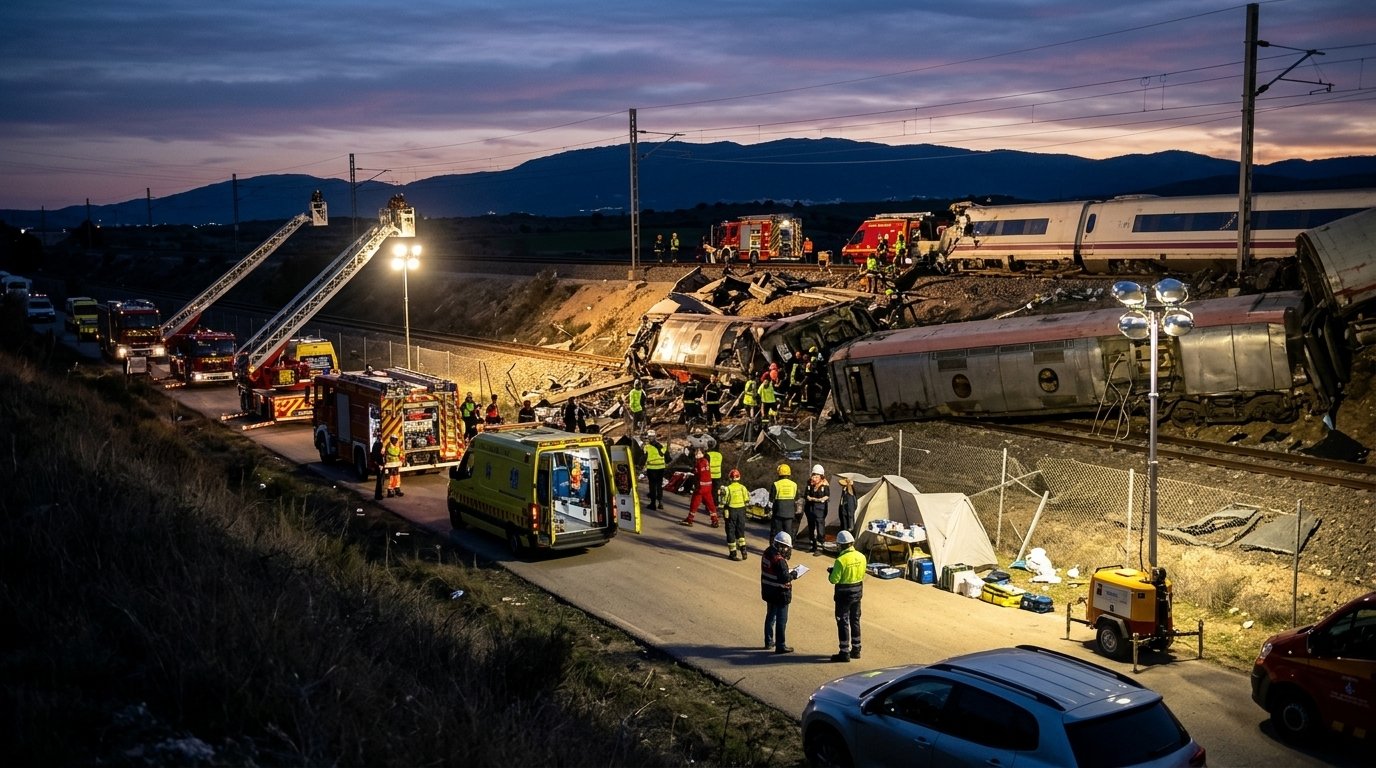
A catastrophic rail collision near Toledo, Spain has claimed at least 68 lives in one of the deadliest accidents in the nation's history. The New York Times reported that traffic controllers mistakenly sent an active train toward another convoy stopped miles ahead.
Key Takeaways
- A train crash near Toledo, Spain killed at least 68 people in one of the country's deadliest rail disasters.
- Spain's Transportation Minister confirmed that traffic control operators gave incorrect instructions that caused the collision.
- Traffic controllers authorized a train to move toward another stopped train miles ahead on the line.
What caused the deadly train collision near Toledo?
Incorrect instructions from rail traffic control caused the disaster near Toledo, Spain, by directing a train onto an occupied line. Spain's Transportation Minister stated that an inexplicable decision by traffic controllers sent a train forward toward another train stopped miles ahead, triggering a collision that killed at least 68 people.
The New York Times reported that the crash ranks among the deadliest rail catastrophes in Spanish history. High-speed and regional rail corridors depend heavily on automated blocks and dispatcher clearance to keep vehicles separated by safe margins.
When an operator overrides standard headway intervals, a train enters an occupied segment without adequate warning. In our experience analyzing transportation breakdowns, clearance directives must always match track occupancy displays to prevent such fatal collisions.
- Monitor transit advisories: Check regional rail schedules and service updates if you plan to travel through central Spain.
Why did traffic control instructions fail to prevent the impact?
Traffic control operations failed because operators issued clearances that directly contradicted basic track safety rules. Instead of halting the trailing train behind protective signals, controllers authorized it to continue along the track, sending it on a direct collision course toward the stopped train miles ahead on the same route.
Rail traffic coordination relies on clear verification before granting track authority. An active train cannot stop instantly, especially when moving at standard cruising velocity, which makes accurate dispatcher commands crucial.
Safety analysts are questioning how such an instruction bypassed normal station safeguards. Investigators must determine whether automated alarms sounded in the control center when the dispatcher cleared the train into an occupied sector, or whether operators misread track monitoring screens.
- Verify travel itineraries: Consult passenger service portals for rerouting announcements across affected passenger corridors.
What will the official investigation focus on next?
The official inquiry will focus on communications and procedural compliance inside the traffic control center during the moments preceding the crash. Investigators need to identify why operators gave the inexplicable order highlighted by Spain's Transportation Minister and whether technical systems attempted to warn the dispatch staff.
Investigators will review audio logs, terminal keystrokes, and electronic tracking records from the control facility. Examining these records reveals the exact mechanism behind the error, showing whether fatigue, miscommunication, or equipment confusion played a role.
With at least 68 deaths confirmed by The New York Times, accountability measures will likely prompt comprehensive reviews of dispatcher certification and automated override protections across the national network.
- Track ministerial findings: Follow official transport ministry statements as investigators release findings regarding rail control room procedures.
FAQ
How many casualties resulted from the Toledo train crash?
The New York Times reported that at least 68 people died in the collision near Toledo, Spain. The disaster stands as one of the deadliest rail accidents in Spanish history, prompting immediate emergency response operations and an inquiry by national transport authorities into the dispatch failure.
What specific mistake did the Transportation Minister identify?
Spain's Transportation Minister stated that traffic control operators issued incorrect instructions that sent an active train directly toward another train stopped miles ahead on the same line. The minister described this controller command as inexplicable, pointing to severe human error within traffic coordination.
Where did the rail accident take place?
The collision occurred on tracks near the historic city of Toledo, Spain. The crash disrupted national rail operations across the region as emergency rescue services secured the scene and investigators accessed the control center responsible for issuing the movement order.
Railway networks require flawless operational execution, and even a single incorrect directive can yield catastrophic consequences. As Spain mourns the victims near Toledo, the focus shifts toward preventing systemic dispatch errors and ensuring that traffic control commands never place passengers in harm's way again.
Stay informed with accurate, up-to-date global news coverage.
Sources
- Spain’s Transportation Minister Said Incorrect Instructions Led to Train Crash (NYT > World News): https://www.nytimes.com/2026/10/28/world/europe/spains-transportation-minister-described-what-led-to-the-crash.html